
The Difference Between the Dark and Light Feminine
Esoeroticism is a form dark feminine magick. But what is the dark feminine? And how does is differ from the light feminine?
Most people are drawn to the dark feminine because they have a craving for something they can’t necessarily name.
They felt it in the moments they were told to be quieter, softer, or more accommodating. They felt it when they followed the rules and still felt like they were disappearing. They felt it in the desire they suppressed, the anger they swallowed, the power they recognized but couldn't quite express.
The dark feminine is not a trend or a temperament. It is an entire half of the feminine spectrum—the half that has been systematically suppressed, demonized, and driven underground for centuries. And understanding it begins with understanding what the full feminine spectrum actually contains.
Feminine Energy: What It Is and What It Isn't
Before we can talk about light and dark, we need to establish the foundation: what do we mean when we say "feminine energy"?
Feminine energy—sometimes called yin or receptive energy—is not about gender. It is an energetic quality that exists within all people regardless of how they identify. Its counterpart, masculine energy, is equally present in all of us. What we are talking about when we invoke these terms is a polarity of qualities, not a prescription for how anyone should be or behave.
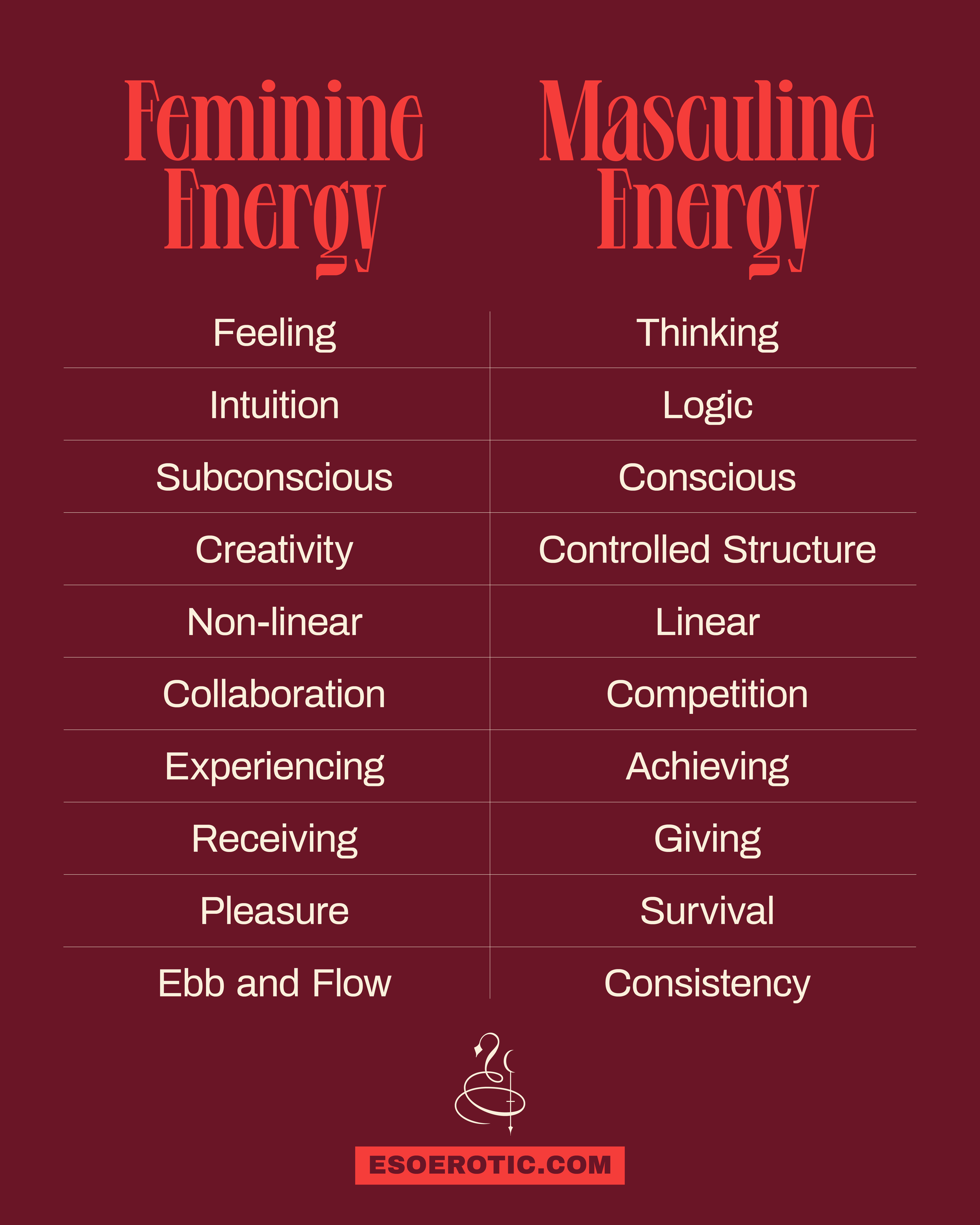
Feminine energy, in its essence, is oriented toward feeling, intuition, the subconscious, creativity, non-linear thinking, collaboration, receiving, pleasure, and the natural rhythms of ebb and flow. It is the intelligence of the body, the wisdom of the cyclical, the knowing that comes not from analysis but from intuitive attunement.
Masculine energy, by contrast, moves through logic, structure, linear thinking, achievement, and consistency. Neither is superior. They are complementary forces, and most of us are navigating a complex internal relationship between both at any given moment.
The feminine polarity we are exploring here—light and dark—exists entirely within the feminine spectrum. It is not feminine versus masculine. It is the full range of what the feminine actually is, before culture decided which parts were acceptable and which parts needed to be hidden.
The Light Feminine: What Has Been Accepted
The light feminine encompasses the qualities of the feminine that society has deemed safe, legible, and worthy of celebration.
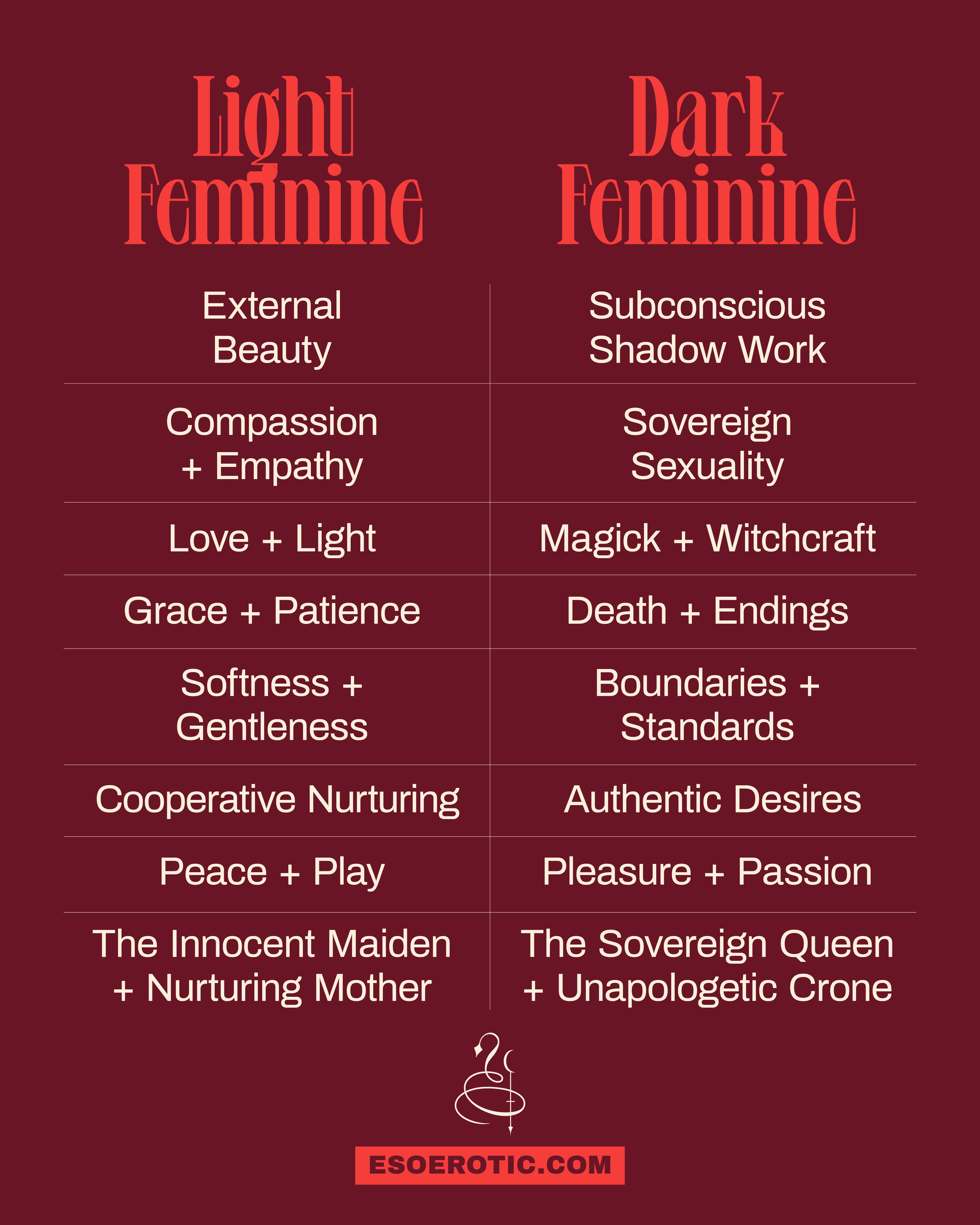
These are the qualities women have been encouraged, rewarded, and sometimes coerced into performing: external beauty, compassion and empathy, gentleness, softness, graceful patience, unconditional nurturing, peacefulness, cooperation. The archetypes most visible in this territory are the Innocent Maiden and the Nurturing Mother who are both beloved, both honored, and both deeply real expressions of feminine energy.
The light feminine is not a problem. It is not lesser. It is not a performance by default. When we tend to others from genuine abundance, when we love openly and radiantly, when we move through the world with grace, that is the light feminine expressed in its healthy wholeness.
There is no inherent problem with the light feminine. The problem arises when the light feminine is the only feminine that is permitted.
When softness is the only option. When nurturing is expected rather than chosen. When the maiden and the mother are the only archetypes valued. That is when the light feminine stops being an expression and becomes a cage.
The Dark Feminine: What Has Been Suppressed
The dark feminine is everything the light feminine is not. Not in opposition, but as its essential counterpart.
Where the light feminine is outward-facing and oriented toward others, the dark feminine turns inward and downward. It is the realm of shadow work and subconscious excavation. Of sovereign sexuality and desire pursued unapologetically on one's own terms. Of magick and mysticism. Of death, endings, and the power to dissolve what no longer serves. Of iron boundaries and uncompromised personal standards. Of authentic desire placed at the center, not the margins. Of pleasure and passion claimed as a birthright, not a reward.
In contrast to the Maiden and Mother, the archetypes that inhabit this territory are the Sovereign Queen and the Unapologetic Crone. Both figures of immense power, both conspicuously absent from mainstream feminine mythology.
The dark feminine has not been suppressed because it is inherently dangerous or nefarious. It has been suppressed because it is powerful in ways that disrupt systems built on feminine compliance.
Consider: those who know their sexuality as innate power cannot be shamed out of it. Those who honor their authentic desires cannot be fully redirected toward selfless service. Those who hold their boundaries cannot be easily controlled. Those who understand they have access to forces beyond the rational, patriarchal framework—that they are, in fact, creatixes—become very difficult to keep small.
The suppression of the dark feminine is not accidental. It is structural. And the work of reclaiming it is, therefore, not merely personal. It is political, spiritual, and deeply somatic.
Why This Distinction Matters
The light and dark feminine are not opposites in the sense that one cancels out the other. They are a spectrum and form a complete whole when fully honored and expressed. The ultimate vision is a femininity so fully integrated that the distinction between light and dark eventually dissolves. Not because the darkness has been sanitized, but because it has been destigmatized.
Most people arrive at this work having mastered the light feminine under duress. They have been soft when they needed to be fierce. Nurturing when they needed to rest. Graceful when they were secretly devastated. They have performed the acceptable half of themselves for so long that the other half feels foreign, frightening, or forbidden.
That is where the dark feminine work begins: not in rejecting who you have been, but in returning to the parts of yourself that were exiled due to shame, fear, and judgement.
In Esoeroticism, the dark feminine is not treated as a phase of rebellion or a healing modality for those who are wounded. It is the philosophical bedrock of the practice and the understanding that our full feminine nature—including and especially its dark dimensions—is not something to overcome. It is something to fully embody.
The light without the dark is incomplete. The dark without the light is imbalanced. Those who learn to move between both with sovereignty and intention are living fully in their feminine essence and power.
That is the threshold this work is built around.
XXX,
Crimson
If you are new to this territory, continue with The Dark Feminine Is Not the Wounded Feminine—the essential distinction that changes how you understand your own darkness. Or explore What Is Esoeroticism? to understand the modality built at the intersection of erotic embodiment and dark feminine philosophy.
